Classes

Thursday, 7 September 2017

Changes at School, CRM, and DuckTales

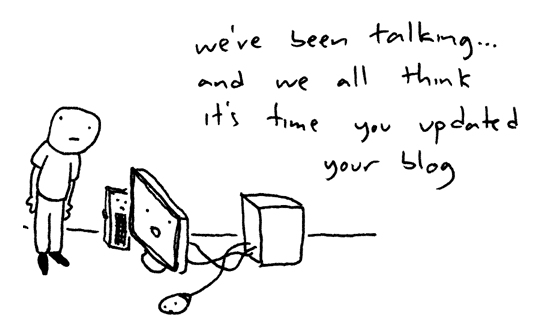
Seems about right.
It is indeed time to get back to blogging.  No excuses and pledges to do better.  Let the blogging do the talking.


Ch-Ch-Changes...

Image result for ch ch changes, bowie

I found out towards the end of last school year that my assignment would be a little different than what I had grown accustomed to.  On one hand, the opportunity to shake things up and try something new can be exciting and, from my own point of view, gives me the chance to experience the enthusiasm and energy that drove me in the early days of my career.

On the other hand, new courses also means that I would need to spend more time over the summer preparing lessons and materials that I didn't necessarily have.  Quite a bit more time, actually.  

I had taught Humanities 8 for the past four years and was really starting to think that I was getting things figured out.  I was feeling very comfortable with the material and was more willing and able to explore new ideas.  I often found myself thinking about how I could use and revisit ideas in the future and make them even better for future classes.  More importantly, though, I was able to work with some of the best teachers I have had the privilege of getting to know.  I was a Middle School teacher and I loved it!  Oh sure, I had difficult and frustrating days, but my place in the school had truly become a part of me.

And then everything changed.

Instead of the safety of Humanities, I would be returning to a revamped and reorganized Grade 9 community with my focus to be on Social Studies.  To further sweeten the pot I was also given a few sections of Film Studies (Yay!), and some Social 20-1 (Grade 11).  The biggest difference, though, was a chance to help establish a brand new course that hadn't been offered at our school before: Media Literacy.

Hearing this back in late May raised a lot of questions...  What is Media Literacy?  Why do students need to take it?  How are we going to grade this?  How can we make this meaningful.  I didn't always feel like I had a lot of direction about where I should be headed along with other colleagues on the team.  And that's certainly not meant to be a criticism... I think a lot of us were in the same boat trying to work out how all the changes would fit together.  If I'm being honest, we're still trying to figure some of these things out.  However, I'm definitely feeling more comfortable about the broad direction of where we are heading... much more so than I did back in May and June.  I even have another blog set up where those of us working with Media Literacy can share some of our thoughts on what we are learning this year.

I certainly don't want to fill this post with too many ramblings but I will also say that a huge part of our approach this year will revolve around the principles of the Collaborative Response Model or CRM.  I'm hoping to be able to share some of the successes (and failures) as I work to use this more regularly in my own practice.

Just a little summer reading...
More to come...


Woo-oo!!

One of my absolute favorite shows as a kid was Ducktales.  I guess it really embodied the sense of adventure that I found myself drawn to throughout the pop-culture I was immersed in.  I'm a sucker for reboots and many efforts to tap into the nostalgia I still have for my early years (looking at you, Classic SNES).  While it's true that many promises have fallen flat over the years, I can't help but be impressed over just how well Disney captured the feeling of the original show.  And improved upon it.


I watched the first episode with my wife and kids and I couldn't help but notice just how much everyone enjoyed it: Mrs. Thompson and I because it tapped into our love of the first and kept going with it, and my boys because it brought something so new and surprisingly fresh.

I'm very much looking forward to solving mystery and rewriting history with this new chapter.

Cheers!

~Mr.T

Sunday, 28 May 2017

High School Redesign, Fidget Spinners, and Viking Cheers


The past month turned out to be a lot more hectic than I had planned on.  There were truthfully quite a few times when I sat down to write but I just kept finding it too difficult to focus in the middle of a myriad of family events and a number of ongoing changes happening within my school... not to mention the demands of the final push to see out the school year.  Time to reconnect with that sweet, sweet blogging therapy.


Making Sense of High-School Redesign

One of the many changes currently being worked on for the upcoming school year is on how CHHS, a grade 7 to 12 school, can successfully incorporate the principles of High School Redesign (HSR).  However, there has been a feeling amongst some of our middle school department, including myself, that we perhaps haven't been fully included in some of those discussions.  This isn't, however, intended to be a critique of school leadership.  It has mainly been a request and plea to see that we are doing our part, along with our colleagues in high school, to build the learning community being sought.

I recently had the opportunity to visit with my new incoming principal and he asked me what I felt about High School Redesign.  When I relayed the sentiment above to him I also expressed my own desire to develop a more thorough knowledge and experience with the guiding principles of this journey.  It was then that I realized just how perfect this space would be for me to address HSR and how it will change how my colleagues and I teach and work with our students.

High School Redesign is based on the following principles:


My hope is to address each of these principles over the coming weeks and months and share a little bit about how I am using them in my own classroom.  It's mainly intended for myself but it's always awesome when I'm able to share something cool with someone else.  

I'll talk first about Mastery Learning later this week.


You Spin Me Right Round, Baby...

After Dabbing, the endless flipping of water bottles, and bags of slime, yet another trend/fad has found its way into our school: fidget spinners.

Maybe I'm old-school / traditional but I wasn't initially convinced when some students excitedly told me just how much these things helped them to focus.  Of course it didn't really help their cause when I saw growing numbers of students staring deeply into the metallic vortex at their fingertips.  It didn't take long before I came up with what I thought was a reasonable compromise.  After explaining my concerns, I said simply that all I was asking for was that I would neither see nor hear any fidget spinner.  This wasn't an outright ban but a chance for kids to evaluate how they were using them.  For what it's worth, it seems to have worked.  At least until whatever the next groundbreaking trend will be.

Graduation and Viking Cheer

It took five years, but I was finally able to attend our high school graduation ceremonies this past week.  One particular highlight of the evening came as our outgoing principal explained that we would be starting a new tradition.  To be fair, we may have had some inspiration but I thought we pulled it off pretty nicely.


More to come...

~MrT

Sunday, 23 April 2017

Mom, Distractions and Technology, and Doctor Who


I have a deep love and appreciation for my mom.  She has always been a great sounding board for my plans and schemes and a tremendous support for me personally and professionally.  On occasion she will send me links to articles or other cool ideas that she thinks might be of interest to me.  Today she sent me a link to a Master's Project by Patrick Tolman that examines the issue of technology usage and how it can be used to help at-risk high school students.  Coming in a hefty 198 pages, the whole thing might not pique the interest of every reader but there were a few points that stood out to me that I will attempt to describe a bit below.

Teachers have to deal with some sort of distraction on a daily basis.  This is increasingly true of the mobile devices that have become so essential in our society.  I've struggled with this a great deal in recent years.  While I LOVE using technology and the cool things that I can do for myself or with my students, there will always be those who are more interested in the games and social media interactions that are all around us.  Many of my colleagues and I regularly discuss the challenges that we have in restricting or even removing devices.  Tolman argues, though, that "removing the devices only gives ... students an additional reason to detach from their educational experience."

In an effort to avoid confrontation, I've tried to find some sort of balance: all devices must be put away when I am giving instructions to the group.  (Edutopia recently put out a video referring to this as 'professional courtesy.')


Once instructions have been given, students are free to work AND use their devices provided they aren't being a distraction for others or themselves.  Those students who choose to remain off-task will have devices taken away.  I'm not perfect at this but many students have begun to at least be aware of the need to regulate what they are doing while in class... at least when I can see them.

Perhaps one of the biggest points that grabbed my attention what what Tolman referred to as FoMA or the fear of missing out.  Social media has created a platform for people to share the experiences that they are having with a much larger audience than just their immediate circle of friends.  Many get hooked on being a part of the action, even if only through a text, Snapchat, or video.  The idea that someone else might be doing something fun or exciting without them is one of the biggest reasons that I see for people 'needing' to be on their phones.  Even when I have claimed a phone or two for a class, some students have really struggled with the thought that they're missing out somehow.  This goes back to the whole distraction piece mentioned above.

So. How do we turn this challenge into an opportunity?  In short, Tolman points out that teachers need to consider a few things:

  • we should not have technology use for the sake of technology use; we cannot assume assume that simply using technology will lead to further learning
  • students should be able to have some input into how their devices are used; they want to use their devices and having a sense of ownership over their education may lead to greater engagement
  • technology use should be targeted to specific purposes within the classroom; there should be a goal in mind and students should be exposed to different programs and apps that might be helpful
He concludes his project by providing a number of lesson plans that have been tailored to include more specific uses of technology.  Tolman argues that by changing his perspective, he was able "to turn a classroom frustration (distracted cell phone usage) into a benefit.  I'm looking at this more in the same way that I will be considering presentational hooks... instead of fighting it, I can be looking for ways to incorporate mobile phones meaningfully into our learning activities.

My summary above might not be the most clear or helpful, so again I recommend skimming looking through the article on their own.

Thanks, mom.


Doctor Who

I don't always follow sports religiously during the regular season but playoff hockey has become a bit of an obsession since I was in Edmonton for the last Oiler's run in 2006.  That means that I'm behind on one or two shows (thank you, PVR) including this one.


I've been encouraged by early reviews so far as I was a lot more confused by the last season than I would have liked to have been been.  I suppose this can be my last hurrah before returning to the regular routine tomorrow.

No spoilers.  ;)

~MrT

Saturday, 22 April 2017

Chocolate, Pirates, and Planet Earth


Now that the Easter chocolate coma (Cadbury Creme and Mini Eggs are supreme) has come to an end, I suppose I should get back to posting.  It certainly wasn't my intention to take this much of a rest from blogging.  However, the combination of submitting report card marks, the much-needed arrival of Easter break, and a potent bout of stomach flu that made its way through half of my family provided more than a few distractions.

There are a few things that I want to touch base on.


Takeaways from 'Teach Like A Pirate'

This was one of those reads that I actually devoured pretty quickly.  I had seen the book before and was really hoping to come across some strategies that would help me to develop greater student engagement.  Every teacher knows that this is important, so just what exactly could Mr. Burgess offer?

I suppose that the biggest thing that I liked about this book was the reminder to let loose and have more fun in my classroom.  A lot of the teachers that I remember the most fondly are those that weren't afraid to be themselves and showcase their own personality and strengths for their students.  I've taken liberties to steal adapt a lot of favourite lessons and activities that I enjoyed with the hopes of being able to capture and recreate the sense of fun that I once had.

It's all too easy to get caught up in all the professional expectations that come with the job... report cards, meetings, grading, meetings, parent contact and outreach, and meetings all come to mind.  This can be a tremendous drain on my enthusiasm and if I'm being honest, I feel more 'tired' after nearly a decade of teaching and don't always feel like I want to put myself out there.  It's just too hard.  Reading TLAP, though, reminded me of why I got into the profession in the first place: I wanted to have a positive impact on the learning of my students.  I am way more likely to have those moments when I can bring my own unique brand of humour and excitement to what I do.  I may not do it exactly as Dave Burgess might do, or any other colleague for that matter.  But that's the whole point... there is a whole outlook on learning and fun that is totally unique to me.  I can focus on that a bit more.


When it comes to actual strategies that I can start using today, the most important thing that I took from the book has to do with using 'presentational hooks'... the key questions that I can ask myself when planning and coming up with lessons and activities.  Burgess provides a good sampling of the kinds of questions that I hadn't really been taking the time to think about in my own practice.  Examples are conveniently broken up into seven different sections that seek to address the different learning styles and interests of students.  Some favourite examples include:
  • How can I incorporate movement into this lesson?
  • Where would be the best place(s) on campus to deliver this content?
  • How can I most effectively use music as they enter the room?
  • What can my students make that relates to the material?
  • And many, many more...
I have to focus quite a bit on what I'm expected to teach.  Like many others in the profession, there is always that feeling that I can't stray too far from stated outcomes and objectives.  However, taking a minute to think about some of these types of questions has already helped to make things a bit more meaningful in the limited time since I read the book.  I'm not just looking at content delivery, but taking a more active approach to consider student engagement.

I look forward to seeing more growth in this area.


Planet Earth II

I can still remember sitting with my parents and siblings in a crowded living room in Edmonton watching the first Planet Earth.  Even before the days of High-Definition and Blu-Ray, all of couldn't help but be amazed at the beauty and wonder of this tiny blue planet.  It was a series that had me uttering frequent wows and left a big impression on me.  It was only natural that I would grab the sequel as soon as I saw it in stores.  Only this time I would get to spoil myself just a little bit more with a larger HD television and improved sound system.

This was an impulse purchase in every possible way: I simply grabbed it as soon as I saw it and went on with my errands.  I had some nagging worries that it couldn't possibly be as good as the first but I can assure you that my fears were quickly put to rest.

The first segment we watched was on islands and there were more than a few moments that left us feeling pretty awestruck.

Like this clip.


I have one more segment to watch but I have once again been left very impressed by BBC to showcase our wonderful planet in such a way.  I highly recommend Planet Earth II for anyone who enjoyed the first series AND if you were one of were one of those who didn't get around to it.

Enjoy your weekend!

~Mr.T

Saturday, 8 April 2017

"Teach[ing] Like a Pirate' and Student Haikus


When I made the decision to start blogging again, I figured I would look at a few things that just might give me the boost needed to counter the growing exhaustion that I really start to feel at this stage of the school year.  I made my way back to something I made a note to check out some years ago but never got around to.  I was still hesitant as I made my order... surely this book couldn't be that good, could it?

Well.  My new reads showed up yesterday and the experience has been refreshing and enlightening.  I've started to actually think that maybe I CAN actually teach like a pirate.

This book has been out for a few years and I'm sure that a number of my teacher friends have checked it out and implemented on some of the many recommendations shared by Dave Burgess.  I don't want to simply regurgitate what I've been reading but there are a few things that have caught my eye so far.

First is the meaning behind the word 'Pirate.'  Burgess has created a straightforward and powerful breakdown for each letter:

  • P... Passion-there is an immense need to be passionate about what we teach, even if we don't like it (lookin' at you, poetry...)
  • I... Immersion-teachers need to set aside the curriculum and really be with students in the moment
  • R... Rapport-we need to be willing to get to know our students on a personal level
  • A... Ask and Analyze-teachers need to ask the right questions, and seek and act on feedback, in order to design lessons that are more effective
  • T... Transformation-we have to recognize when our approaches to teaching need to be changed and reframed
  • E... Enthusiasm-teachers need to share our excitement freely throughout the day and with every class

I'm still working on the book but I want to circle back to the first section on passion.  At the risk of revealing far more than I should, Burgess divides passion into three separate areas, one of which involves our personal passion.  In a nutshell, he argues that we need to be far more willing to incorporate our own passions into our work.  I'll admit that there are lots of times during the year where I feel guilty for taking time for myself.  I could read that book, go airsofting, or play that game but I should really tackle that marking that's been building up or figure out how to teach my students about writing essays.  For that reason, I've maintained a degree of separation that has perhaps prevented me from allowing myself to get too excited about the stuff that I care about.  That isn't to say that I don't have fun during the school year but I have probably been denying myself the opportunities to grow and amplify that sense of fun and excitement in my own classroom.

While reading "Teach Like a Pirate," I started to think about the things that I am truly passionate about: quality time with family, games (board and video), technology, news and current events, planning big trips... some of which I might even go on, music, etc.  Burgess points out that listening to someone who is truly excited about something has a certain hypnotic quality to it: we just can't look away because they're so captivating.  I think there are some exceptions to that rule but they are admittedly few.  Surely there are some ways that I can bring my own passion a bit more regularly into my job.  Not many people, in teaching or otherwise, can probably claim that they get to do that as often as they would like.

More to come on this one, but in the meantime I'd challenge you to think about your own passions and start thinking about how you can bring that out a bit more.


Haikus

Somewhat related to the first section, I've been trying to give my Humanities classes some exposure to poetry.  Those who know me figure out pretty quickly that I'm pretty passionate about Social Studies and maybe less so about Language Arts.  I know it's incredibly important and I do my best to cover the required outcomes, but... I don't always feel that I have the enthusiasm that would convince most kids that what I say has that much relevance.

I hit a snag a few weeks back while looking at a few examples of poetry.  Suffice it to say that everyone... and I mean EVERYONE... was checked out.  I felt that in spite of my preparations and approach, I was failing and that I was wasting everyone's time.  So I returned to an old favourite that I had done when I first started teaching Humanities.  Truthfully, though, I stole the idea from my own Grade 8 LA teacher.  I liked doing it and figured my students could get behind it, too.

After introducing an activity that had them analyze and interpret a song of their choice, I introduced Haikus.  I introduced the structure as I had been taught and most would today approach it.  However, I also shared this video from perhaps one of the greatest cartoons ever made:


I gave my students their assignment: write three Haikus about any topic of their choosing as long as at least one of them had something to do with nature.  The results have been pretty impressive to say the least.


I emphasized that with the limited syllables, each and every word and sound mattered.  I saw students grabbing their thesauruses, and sharing their poems with one another.  There was even one student who was determined to create for me the ultimate sensory Haiku: he would write one about Dr Pepper and also provide one that I could drink while reading his poem.  

He wrote:

Cold Dr Pepper
Refreshing Mr. Thompson
Twenty Three Flavours

While I'm still waiting for that Dr Pepper, I saw what Dave Burgess was talking about: kids laughing and having fun being silly or reaching a little deeper and trying to capture the essence of the images that they chose.  Since putting up all the class poems that I've collected, 'The Wall' has been a popular hangout for students before and after class as they read what others have done.

I can do that more.


Video of the Week

I don't always watch Jimmy Fallon but I have loved most of the videos and snippets from his show.  This one was particularly enjoyable.  Enjoy the rest of your weekend!


~Mr.T